When to Fly the Flag
The Basic Rules of Flag Etiquette
- The flag may be flown 24 hours a day as long as it remains illuminated.
- If the flag is not illuminated it should only be flown from sunrise until sunset.
- The flag should be taken down during inclement weather so that it does not get wet.
- When lowering and storing the flag, it should not be allowed to touch the ground.
- On a pole, the flag’s field of stars should be on the top. An upside-down flag signals distress, or governmental protest.
- When displayed with other flags, the Stars and Stripes should occupy the center and highest point.
- On a dais or pulpit, the flag should be placed to the right of the speaker or minister.
- When the flag is no longer fit to display, (torn, frayed, faded, etc.) it should be destroyed in a dignified way, not simply thrown away.
- When the flag passes in a parade, observers should stand and salute it by placing their hat, if covered or their right hand over their heart.
- If a veteran or active duty, in or out of uniform, a full military hand salute should be rendered.
- When a flag is flown at half-staff to signify mourning, it should first be hoisted briefly to the top before being lowered again.
- The flag should be hoisted again to the top before being removed.
- On Memorial Day, the flag should be flown at half-staff only until noon, then raised to the top.
- If the flag is displayed during the national anthem, everyone should face it and salute.
- The flag should not be used as a drape at the unveiling of a statue or monument.
- A flag may be used to cover the coffin at a funeral, but it should be removed before the coffin is lowered into the ground. It may be used again after.
- The POW MIA Flag is authorized to be flown below or beside the American Flag.
Retire your american Flag
Where can I take an American flag to be retired in Vacaville?
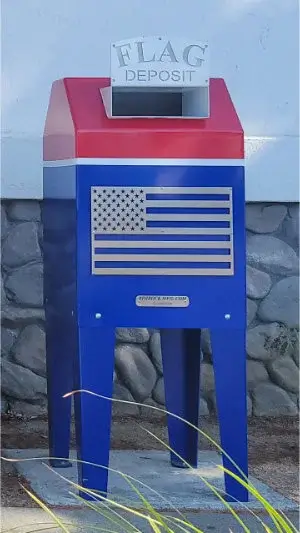
Flags that are no longer serviceable may be dropped off at the Vacaville Veterans Hall. We are located at 549 Merchant St., Vacaville, CA 95688. In front of the building, next to the memorial bench, is a well marked, converted mailbox where you can retire your flag.
When should I retire an American Flag?
The U.S. Flag Code (Title 4, Chapter 1 of the United States Code) states that a flag should be retired when it is “in such condition that it is no longer a fitting emblem for display”. Some examples are:
How does the Vacaville Veterans Hall retire an American flag?
American Legion and Scouting America are authorized to respectfully burn or provide a burial in accordance with U.S. Flag Code.
Additional Flag Drop Off
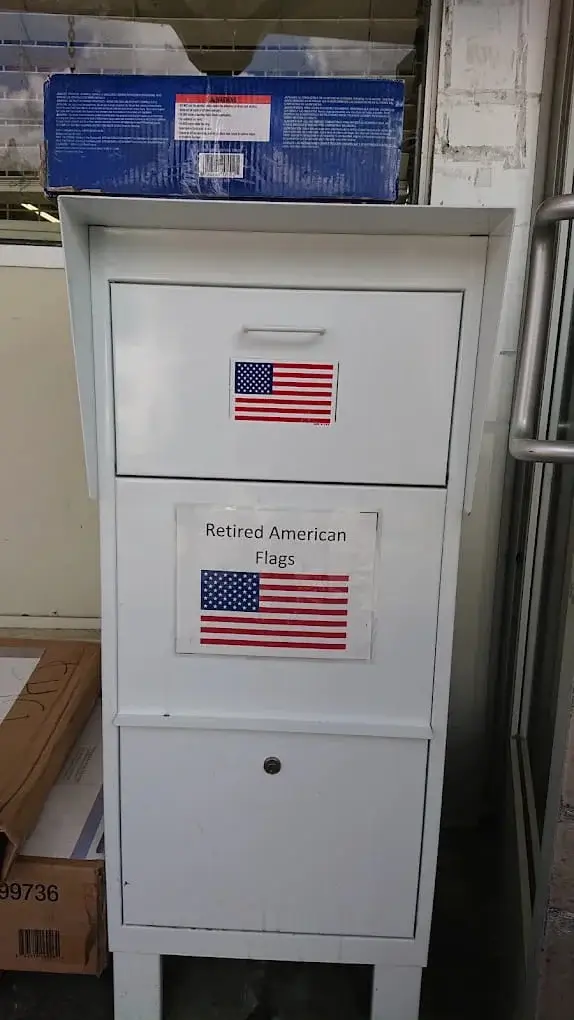
Pacific Ace Hardware has a flag drop box to the left of their front door.